Women With Climbing Antibodies Say These Drops Work "Unlike Anything Else"
A functional medicine physician exposes why the right dose, strict diets, and every supplement still leave Hashimoto's women exhausted, foggy, and shedding — and the overlooked drainage that finally turned Susan Marsh's antibodies around.

You take the pill every morning. You never miss it. You cut the gluten, then the dairy, then everything the protocol said to cut. And your labs still come back optimized. But you're still shedding in the shower. Still puffy around the throat. Still asleep in the chair by two in the afternoon. You are not imagining it. And your dose is not the problem.
Last February, a little after two on a Tuesday, Susan Marsh was at the front desk of the elementary school office in Sacramento where she'd worked for years.
A mother stood on the other side of the counter waiting to sign her son out early, car keys hooked over one finger.
The sign-out sheet was in front of Susan. The pen was in her hand.
And she could not keep her eyes on the line. The words slid.
She blinked hard, looked at the wall clock, looked back down, lost the line again.
Her thumb had found the worn edge of the laminate counter, the spot where the top layer had peeled up years ago, and she was pressing it flat, over and over, without knowing she was doing it.
"Sorry," she said. "Sorry — one second."
The boy leaned on the counter and spun a paperclip.
His mother smiled — the small, patient smile you give someone who's clearly having a rough day. Susan's coffee sat by the phone.
She'd poured it at one. A thin skin had formed across the top.
She never touched it. She got the boy signed out.
Then she pressed two fingers to the base of her throat, where the skin felt thick and full, and she sat very still with both feet flat on the floor until the counter stopped swimming. "I told myself this was just what Hashimoto's does," Susan says. "That some women get to feel okay, and I wasn't one of them." Dr. Patricia Bennett, a functional medicine physician who has spent 14 years watching women's antibodies climb, says Susan's case is the one she sees most. "Her medication was doing its job. Something else in her neck was not."
The Advice Every Hashimoto's Patient Hears, And Why It Failed Susan

The standard line is simple. Your antibodies are high because your thyroid is under attack, so replace the hormone, cut the trigger foods, and wait. So Susan did all of it. Eleven years of the same levothyroxine every morning, the bottle set by the toothbrush so she'd never forget.
The selenium and the ashwagandha sat in the bathroom drawer, both bottles nearly full. She'd read that they helped. They hadn't, not that she could feel.
And every six months the printout said the same word. Optimized.
While her TPO antibodies climbed anyway, and the brush kept filling, and the throat kept feeling thick. "We've been treating the wrong half of this disease for decades," says Dr. Patricia Bennett, a functional medicine physician who specializes in Hashimoto's. "The medication replaces the hormone the gland can't make. That's real, and it matters. But it does nothing about the immune debris piling up in the tissue around the gland." That debris is the part nobody looks at.
And it's the reason Susan's numbers moved the wrong way no matter how perfect her chart looked.1
The Clogged Drain Around Your Thyroid
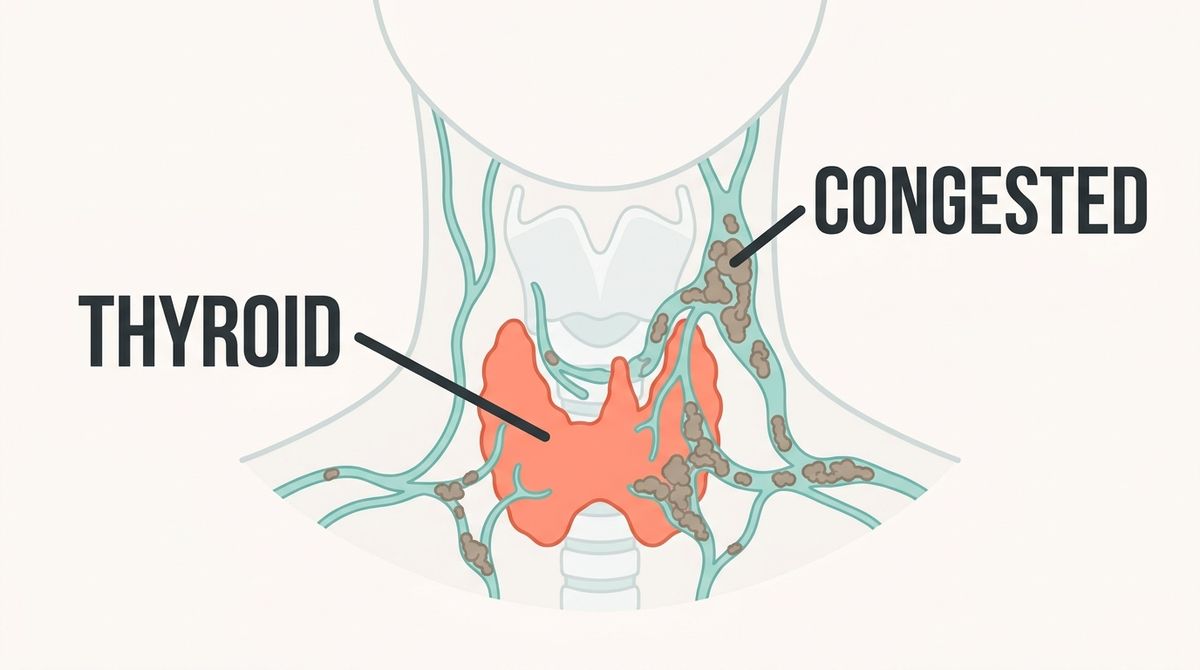
Here's what's actually happening. Your thyroid sits inside a dense web of lymphatic vessels, tiny drainage channels in your neck whose job is to carry waste away from the gland.
When your immune system attacks the thyroid, that attack leaves behind debris: broken-down cells, inflammatory byproducts, immune junk. Normally the lymph drains it off. But with age and years of inflammation, those channels get congested. The waste stops moving.
It settles right back around the gland. Think of a kitchen sink with a packed drain.
You can pour clean water in all day, the right pill, the right dose, but the sink still fills with dirty standing water, because the drain underneath is clogged.2 And here's the cruel part: that trapped debris keeps the immune system agitated.
So the attack never quiets. The antibodies keep climbing.
The $1,100 Route Susan Almost Took Next
When the diets and the supplements failed, Susan's next appointment came with a new suggestion: a specialty biologic to suppress the immune attack directly. Roughly $1,100 a month out of pocket. Weekly injections.
A list of side effects that made her put the pamphlet down on the kitchen table and not pick it back up. And here is what stopped her cold. Even that drug, Dr. Bennett explains, works on the water going in. "It quiets one part of the immune signal," she says.
"It does nothing to clear the debris already packed around the gland. You suppress the attack from the top while the drain underneath stays clogged. The moment you stop, the standing water is still there."
Susan wasn't looking for something stronger to pour in. She was looking for someone to unclog the drain.
Reality of the Biologic Route
- Cost: ~$1,100/month, rarely fully covered
- Delivery: Weekly self-injection
- Side Effects: Suppressed immunity, infection risk
- Availability: Specialist prescription, prior authorization
- Stopping: Attack returns, the debris was never cleared
What Diane Found When She Kept Pulling the Thread

That gap, everyone treating the water, nobody touching the drain, is what sent this reporter looking for who, if anyone, was working the other end of the problem. The trail kept circling back to old herbal practice, not a lab. For centuries, before anyone measured an antibody, certain plants were used for one job: to get stagnant lymph moving again.
Cleavers was the name that came up over and over, traditionally called the lymphatic mover. Not a hormone. Not an immune suppressant. Something that worked on the vessels themselves. Dr. Bennett had arrived at the same place from the clinical side.
"I stopped asking how to quiet the attack," she says, "And started asking how to clear what the attack leaves behind. That's a drainage question, and the answer was never going to be another pill you swallow." That last part mattered more than it sounds.
A capsule has to survive the gut before any of it reaches the tissue around the throat. So the approach that earned a serious look was sublingual, drops held under the tongue, absorbed straight in, delivered close to where the congestion actually sits.
The working blend paired cleavers with dandelion root and prickly ash to open the exit routes, then calendula, burdock, rose hip and a few others to calm the tissue so it wouldn't simply re-clog. Loosen the gunk. Flush it out.
Keep the drain open. It was the first thing Diane found that was aimed at the clog instead of the water.
How Cleantra Clears the Clogged Drain
Dr. Bennett explains the blend the way she explains it to patients: it works on the drain, not the water going in. The idea is simple. Break up the gunk packed in the vessels around the thyroid. Open the exit so it actually leaves.
Then keep the pipe from clogging again. Three moves, in order.
- Loosen (first days to weeks), Cleavers, the lead herb, is a traditional lymphatic mover; echinacea and burdock root work alongside it to break up the stagnant debris and inflammatory byproducts sitting congested in the vessels around the gland.
- Flush (weeks two to four), Dandelion root and prickly ash bark open the exit routes so the loosened waste actually leaves the tissue instead of settling right back around the thyroid.
- Keep it open (ongoing), Calendula, rose hip, red clover, blue vervain, and elderberry calm the inflamed tissue and support the vessel walls, so the drainage keeps moving instead of re-congesting a month later.
What Happened When Susan Stopped Pouring Clean Water Into a Clogged Sink
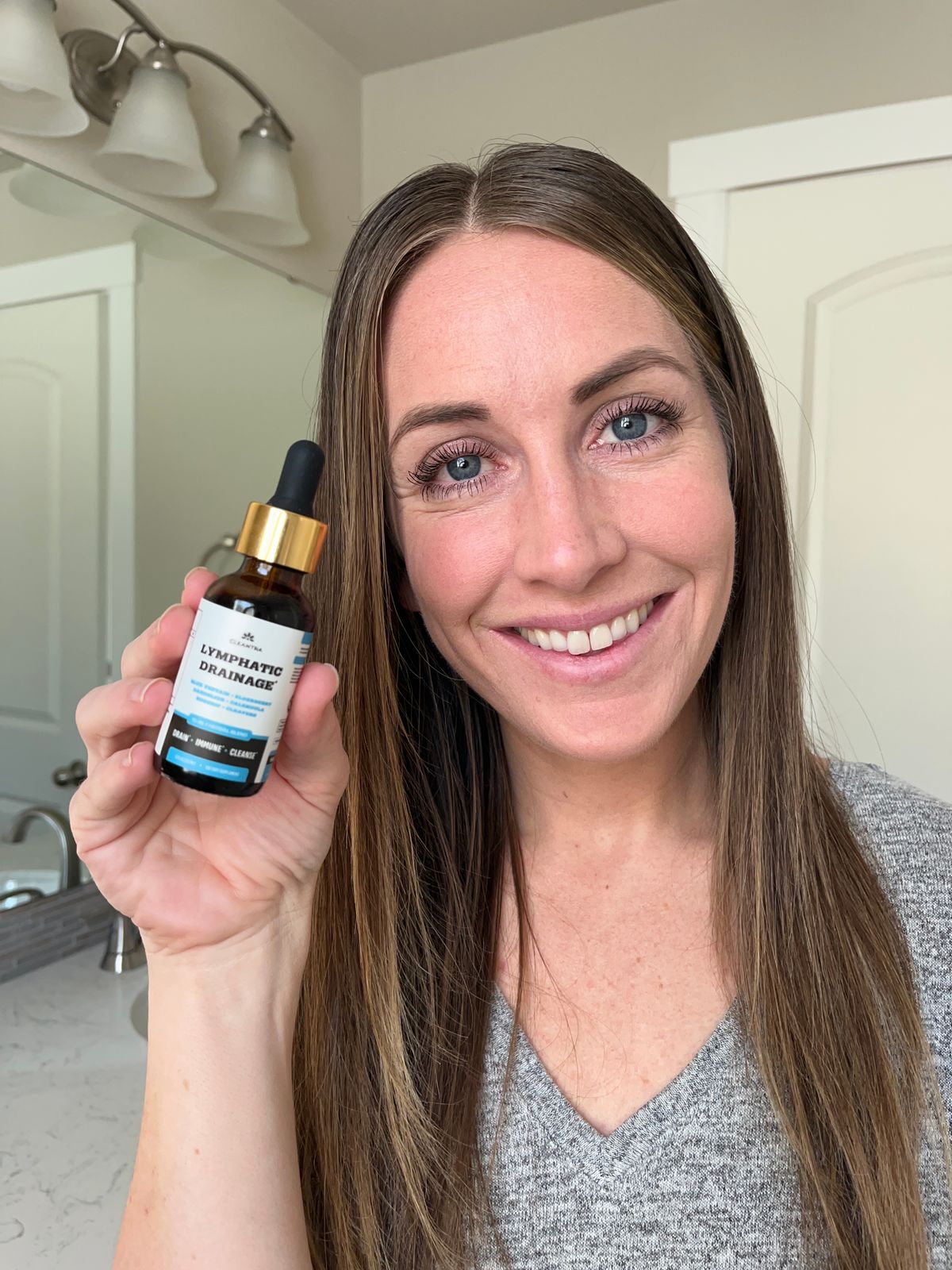
Susan started the drops under her tongue every morning, right beside the pill she'd taken for eleven years. The first weeks, nothing she could point to. Then one morning at the mirror the brush came away lighter. Not empty. Lighter.
She turned it over in her hand twice to be sure. The thick, full feeling at the base of her throat eased. Her collars sat different.
Several months in, at a routine draw, her numbers moved for the first time in years — the antibody trend that had climbed for 14 years finally turning down.
And on a Saturday not long after, she opened the cupboard and took down the little ceramic teapot that had sat washed and dry there for over a year. She filled it.
Her granddaughter sat on the bathroom tile while Susan French-braided her hair, and the two of them were still at the table when lunch came — Susan awake for all of it.
Why Your Endocrinologist Never Mentioned the Drainage
Here's the uncomfortable part. There is no pill for a congested drain. You can't patent a handful of wild-sourced botanicals.
So there's no company with a reason to fund the studies, train the doctors, or put it in the guidelines. Meanwhile the thing that DOES get studied, hormone replacement, antibody-lowering protocols, the next dose adjustment, is a market worth billions.
Every refill, every follow-up, every panel is revenue. Dr. Bennett is blunt about it. "We're trained to measure the gland and the blood," she says.
"Nobody teaches us to ask whether the tissue around it is draining. The lab comes back optimized, so we tell the patient she's fine, and she walks out still exhausted, still shedding, still puffy." It isn't a cartoon villain in a boardroom.
It's a training gap that nobody's paid to close. So women like Susan spend fourteen years watching their antibodies climb, doing everything right, while the one thing that would've quieted the attack never gets looked at.
How Susan Actually Got Her Hands On It
You won't find it on Amazon, and Bennett says that's on purpose. The botanicals are wild-sourced and hand-pressed in small batches, so the company sells it straight from their own site to keep every bottle at full strength instead of splitting stock across resellers. One dropper under the tongue every morning. "I tell my patients to order direct," Bennett says.
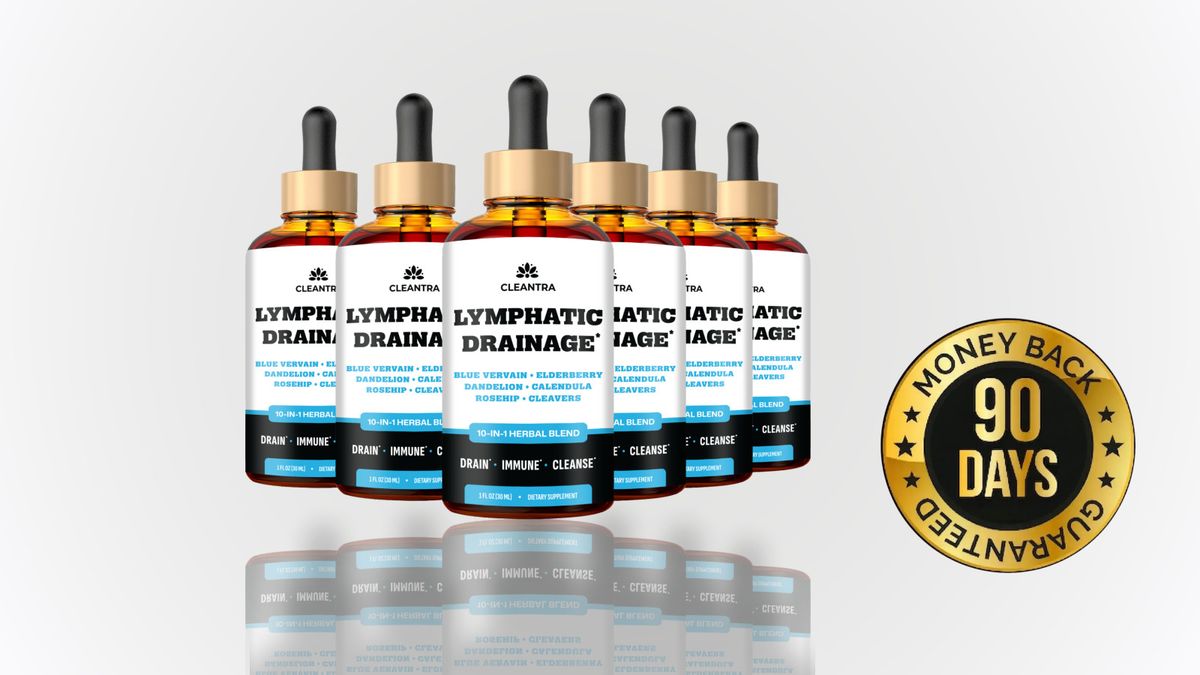
Susan expected it to cost what a month of a $400 specialist panel runs. It doesn't. It's normally $149.70 a bottle. On this page, today, it's $74.85. And there's a 90-day money-back guarantee, the whole point being that the drainage doesn't turn until you've given it several honest months.
If the antibodies don't budge and nothing shifts, you send it back and you're out nothing but the time.
The Teapot Is Back On The Counter
None of this was ever about a dose you got wrong or a diet you didn't follow hard enough. The drain underneath was clogged, and no one you paid was looking at the drain.
You were pouring clean water in for eleven years while it stood dirty in the basin.
Here's the part Bennett wants women to sit with. Debris that keeps circling the gland doesn't sit still, it keeps the attack lit. Every month it stays trapped, the tissue stays inflamed and the antibodies climb off that inflammation.
The women who waited two more years came in with numbers that had climbed the whole time they waited. Susan's teapot is out of the cupboard now. Two grandkids at her kitchen table on a Saturday, and she's awake for all of it.
The wild-sourced batches are hand-pressed and small. Runs sell out, and the next harvest takes its time.



REFERENCES
- Breslin JW, et al. "Lymphatic Vessel Network Structure and Physiology." Comprehensive Physiology. 2019;9(1):207-299.
- Weiler MJ, et al. "Sensitivity Analysis of Near-Infrared Functional Lymphatic Imaging." Journal of Biomedical Optics. 2012;17(6):066019.
- Caturegli P, et al. "Hashimoto Thyroiditis: Clinical and Diagnostic Criteria." Autoimmunity Reviews. 2014;13(4-5):391-397.
- Ventura M, et al. "Selenium and Thyroid Disease: From Pathophysiology to Treatment." International Journal of Endocrinology. 2017;2017:1297658.
- Cleantra Functional Wellness, internal practice notes and customer-reported outcomes, 2025-2026.